
· Nate Halloran
Tamping and wrist pain: what puts the joint at an angle
People who tamp several times a day notice their wrist eventually, and the first instinct is to press more gently. That is the wrong dial. The morning it registers is rarely the morning you pressed hardest — it is a joint working at an angle, a few seconds at a time, for months.
What follows is about the setup rather than the technique. The gesture itself is a separate subject and lives in how to tamp espresso.
What occupational health actually blames
Borrow from a field that has studied this for decades. The Canadian Centre for Occupational Health and Safety — CCOHS, which publishes Canada’s occupational health fact sheets — defines work-related musculoskeletal disorders as “a group of painful disorders of muscles, tendons, and nerves,” and lists carpal tunnel syndrome and tendinitis among the examples. Those are conditions a clinician identifies, not a website, and nothing here can tell you whether any of them applies to you.
What the document is useful for is the list of conditions under which trouble develops. CCOHS associates these disorders with work patterns that include “fixed or constrained body positions,” “continual repetition of movements,” “force concentrated on specific parts of the body, such as the hand or wrist,” and “a pace of work that does not allow sufficient recovery between movements.” Three of those four describe a home coffee bar, and the third names the part in question.
Then comes the line that reframes everything: these disorders “commonly occur as a result of a combination and interaction among these factors.” Not one alone. Which is why pressing more gently rarely changes anything — it addresses one item of four and leaves the position, the repetition and the recovery where they were.
Counter height sets the angle before you touch anything
Start upstream: the height of the surface decides where the elbow sits, and the elbow decides what the forearm can do. CCOHS gives working heights relative to the elbow in Working in a Standing Position, one per kind of task. Precision work belongs “about 5 cm above elbow height; elbow support is needed.” Light work such as assembly or mechanical jobs belongs “about 5-10 cm below elbow height.” And the category that applies here, “heavy work, demanding downward forces,” belongs “from 20-40 cm below elbow height.”
A tamp is a downward force. A small one, but direction is what decides where the surface should be, and by that measure almost every kitchen counter is too high: counters are built for chopping and washing, which are light work. When the surface is high the elbow rises, the arm can no longer press straight down through its own length, and what makes up the difference is the wrist.
You will not rebuild a kitchen over a coffee, and you do not need to. CCOHS’s remedy for a surface that cannot be adjusted is to move the body instead — here, inverted: do not press at whatever height the portafilter happens to be resting. Bring it down.
The bent wrist, and the three ways it bends
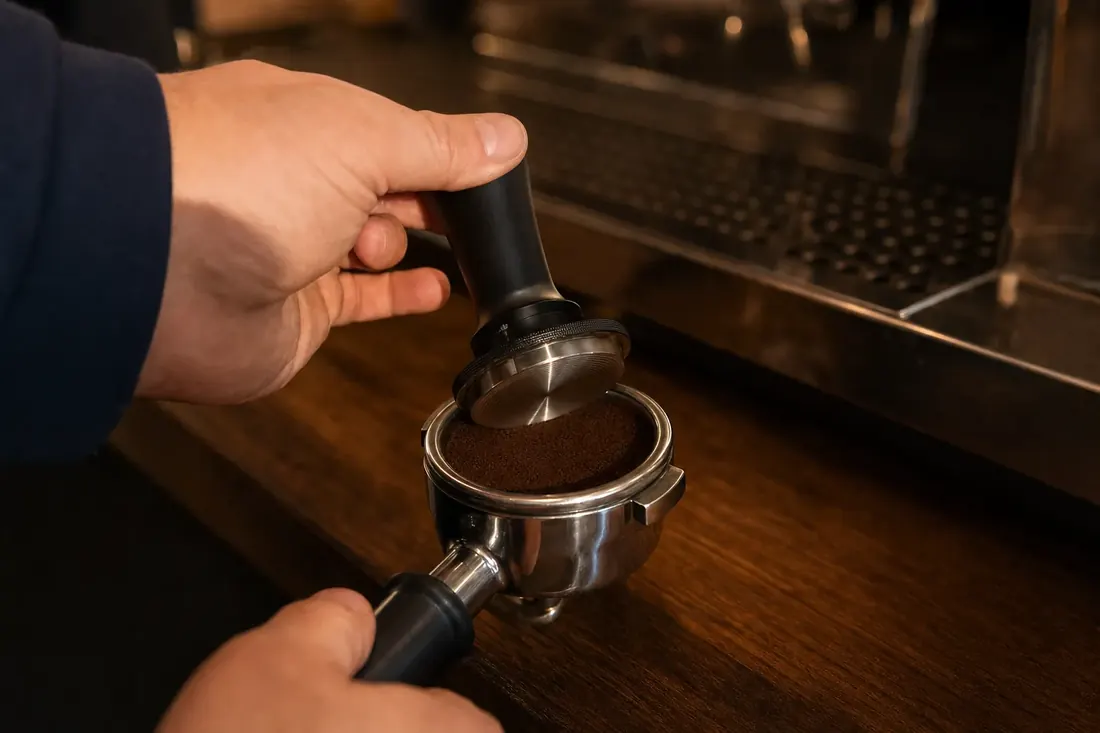
Now the joint. People call it a “broken” wrist: one folded at an angle rather than carrying on the line of the forearm. CCOHS names three separate ways a wrist leaves that line, in Hand Tool Ergonomics – Tool Design: “Select tools that do NOT require wrist flexion, extension or deviation. In other words, select tools that allow you to keep the wrist straight or in a neutral position.”
Naming the one that is yours is what makes it correctable. Flexion is the palm folding toward the inside of the forearm, the shape a hand makes curling under a handle gripped low. Extension is the reverse, the back of the hand rising toward the forearm — what a high counter produces automatically, since the elbow cannot get above the tamper and the hand tips back to keep the base flat. Deviation is sideways, toward the thumb or the little finger, and it is the one nobody notices, because it comes from standing beside the portafilter, not behind it.
A neutral wrist is the absence of all three: hand, wrist and forearm on one line.
Where the portafilter sits, and what your other hand is doing
The rest of the geometry belongs to the hand not holding the tamper. The first of two ways people present the portafilter is holding it up in one hand, out in front of the body, tamping into mid-air: the supporting shoulder carries a load at a distance, the target can move, and the wrist takes whatever angle is left over. CCOHS asks in Working in a Standing Position that tools be positioned “so the worker can reach them easily and without twisting or bending,” and its hand-tool guidance is to “keep your elbows close to the body, and reduce the need to stretch your arms overhead or out in front of you.” A portafilter held at arm’s length fails both.
The second is to set it down and let a surface hold it — a mat with a lip, a stand, the corner of a bench. The supporting hand goes from carrying to steadying, the elbow comes back near the body, and the pressing arm is free to choose its own height. That change makes all the others possible: until the target stops moving, no attention to the press can straighten the arm above it.
Lining the forearm up with the push
Put the pieces together and one instruction runs underneath them: get the tamper under the elbow, the elbow under the shoulder, and press down that column. CCOHS states the principle for hand tools in five words: “bend the tool, not the wrists.” And it is specific about which shape belongs to which direction of force, in a sentence that describes tamping almost exactly: “Tools with straight handles are for tasks where the force is exerted perpendicular to the straightened forearm and wrist, for instance, when the force must be applied vertically.”
That is the argument for the shape of a tamper handle, written by an agency that has never thought about espresso. A tamp is a vertical force, and the press then comes from the arm and shoulder rather than being corrected at the smallest joint in the chain.
What the shape of the tamper changes
A tamper is a hand tool rather than a medical device, and what it changes is mechanical: how your hand closes around it, and where the push ends.
The first is grip. Outside precision work, CCOHS says, hand tool handles “should be designed for a power grip” — one where “the operator can align their fingers towards the palm, using their entire hand.” It contrasts this with a pinch grip, “holding an object between the thumb and fingers of a single hand.” The stub handles moulded onto the tampers that ship clipped to a machine invite the pinch: with no room to close a whole hand, the fingers take the load and the wrist stabilises the rest. A full-length handle puts that load in the palm, where CCOHS wants it.
Ours comes in two handle shapes, and the choice is comfort rather than performance. The straight handle is tapered and suits a press from the heel of the palm, the configuration CCOHS describes for a vertical force. The rounded bulb fills the hand and suits a wrap-around grip. Both carry the same base, spring and depth collar; the size guide covers choosing between them.
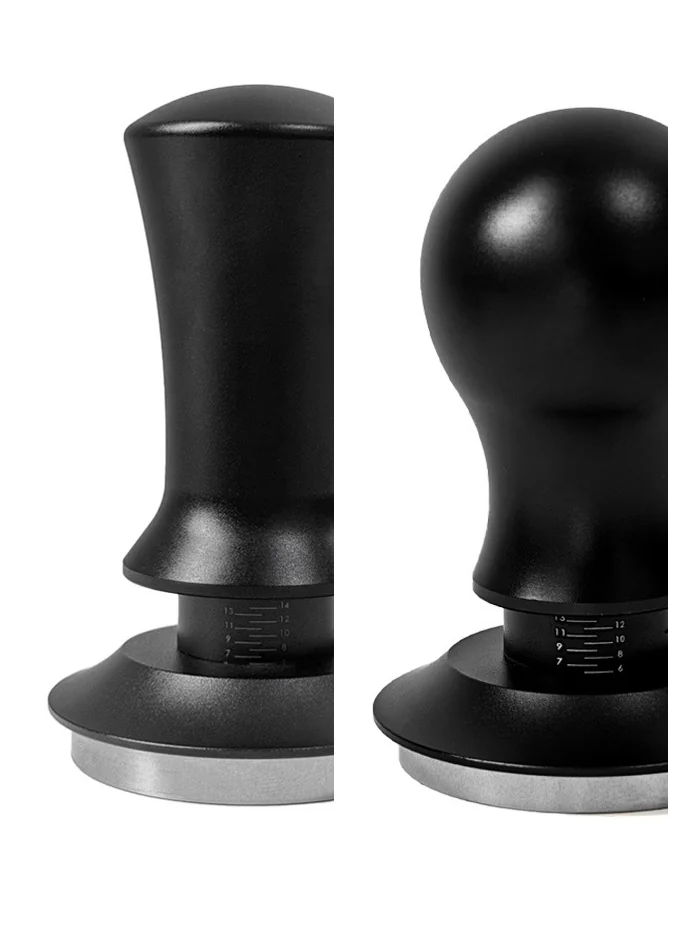
The second thing shape decides is where the push stops. A base machined to seat on the rim cannot enter at an angle, which removes the sideways correction the wrist would otherwise make at the end of every press. And a spring that gives way at a set load ends the movement at the same point every time, so there is no leaning in to check whether the bed feels solid yet. On our espresso tamper the spring is fixed and the numbered collar sets depth, not force — the mechanism is on the calibrated tamper page.
Repetition, not force, is what stacks up
Here is where a number would normally go, and here is why this article prints none. Search for a tamping force and you will find one figure quoted everywhere; how much tamping pressure you need traces how it travelled from commercial bar practice to a domestic kitchen without the basket it described. What no health or ergonomics body publishes is an “ideal” tamping force in pounds or kilos — because a load on a joint cannot be judged without knowing the angle it arrives at, how often it arrives, and what recovery there is in between.
CCOHS puts the three together: what makes ordinary movements hazardous at work is “the continual repetition, often in a forceful manner, the speed of the movements, and the lack of time for recovery.” Repetition opens that sentence and recovery closes it. Force sits in the middle, qualified.
A home coffee bar is quietly repetitive. Two or three coffees a day is a small number until you multiply it by a year, and the presses are near identical. Notice, too, which day people report trouble after: rarely a normal Tuesday, more often a weekend of dialling in a new bag, twenty presses in a morning, every one at the same angle. So the variable to change is not how hard the press is but how many identical, angled repetitions the joint gets — straighten the column and the same count arrives somewhere better. A tamper that stops at a fixed load removes the leaning-in and the second press to check: the calibrated coffee tamper gives the same signal on the twentieth repetition as on the first.
When to stop and ask someone
Setup is a matter for a website. Symptoms are not. CCOHS describes an early stage in which “aching and tiredness of the affected limb occur during the work shift but disappear at night and during days off work.” The stages after it are defined by what stops disappearing: aching that persists at night, then fatigue and weakness that persist at rest. If discomfort in your hand or wrist is still there when you have not been near the machine — overnight, or across a few days away from it — that is the point to take it to a doctor or a physiotherapist rather than to a forum.
Two more lines from the same document should travel with you. The first: “The first pain, numbness, or tingling are signals that the muscles and tendons should rest and recover. Otherwise, an injury can become longstanding, and sometimes irreversible.” The second is why this article prescribes no exercises, stretches or supports: CCOHS states that “people suffering from WMSDs should consult a physical therapist before exercising,” because “stretching or exercise programs can aggravate the existing condition if not properly designed.” A routine copied off a page that has never seen your wrist is exactly what that warning is about. What belongs here is the counter, the mat and the angle.
None of this is alarming in itself: most people who notice their wrist after tamping are noticing a setup, and a setup is the most changeable thing in the room.
Where to go next
Change the geometry first, and in this order, because each step makes the next possible. Put the portafilter down on something that holds it. Get that something lower than the counter you have been using, closer to the range CCOHS gives for a downward force. Stand behind it rather than beside it, and let tamper, wrist, elbow and shoulder stack in one line.
Once the column is straight, the tool under your hand does the rest: a handle your whole hand can close on, a base that seats flat on the rim, and a stop that ends every press at the same point — described in full on the espresso tamper page.
Related reading: how to tamp espresso · how much pressure you need · what a coffee tamper is · ripple base vs flat base · tamper vs distribution tool · how to clean a coffee tamper · coffee tamper substitutes · choosing the best coffee tamper
On the product: the calibrated coffee tamper · which size fits your machine · how the spring works · what buyers report