
· Nate Halloran
Coffee tamper substitutes: what works if you don’t have one
The machine is warm, the coffee is dosed, and the tamper is the one thing the box did not contain — or it is in a moving carton, at the office, or wherever small single-purpose objects go to hide. This article is about closing that gap with what the kitchen already holds: which objects press a usable bed, what to check before you press, and exactly where the improvisation stops. If your question is what the tool itself does, or why espresso needs compressing at all, that has its own article: what a coffee tamper is. This page assumes you want a shot tonight.
Match the diameter before anything else
Espresso baskets come in a small number of sizes: 51mm on most compact machines, 53 to 54mm on Breville and Sage, 58mm on full-size machines. A real tamper is bought to match, and the whole reason it works is that its base covers almost the entire bed. Whatever you improvise has to pass the same test, because water at nine bars does not forgive the edge. A stand-in well under the basket’s diameter compresses a circle in the middle and leaves a ring of loose grounds around it, and that ring is an open door: the shot pours pale and fast through the gap while the compressed centre sits there barely touched.
So audition objects against the basket, not in your hand. Hold each candidate face down over the empty basket: you want it to drop inside with only a whisker of air around it. If you are not sure what your basket measures, the size guide shows how to take the number off it with a ruler in a minute.
Between two candidates, take the one closer in diameter even if it is more awkward to hold. Grip can be worked around; diameter cannot.
The kitchen shortlist
Three families of objects keep coming up, because most kitchens hold at least one of each. What separates them is not how much they resemble a tamper — it is how flat the pressing face is, and how close it comes to the basket wall.
| Stand-in | Why it gets reached for | What to check before pressing |
|---|---|---|
| The base of a glass | Flat face, easy to hold, every kitchen has one | The bottom must be truly flat — many glasses carry a raised rim or a dimple |
| A pestle or a muddler | Handle shape and weight feel closest to the real tool | Most pestle faces are domed; only a genuinely flat end will do |
| A jar lid or a wide cap | Often the closest diameter match in the house | Undersides hide ridges and threads, and thin metal flexes in the middle |
And one rule covers everything else: nothing painted, printed or coated goes anywhere near your coffee, and neither does anything you cannot wash first.
The bottom of a glass
The upturned glass is the default for a reason: it is the object most likely to combine a flat face with a diameter close to a small basket. Audition it first. Turn it over, set it on the counter and sight across the base at eye level. What you want to see is boring — an even face, no raised ring, no dimple. Plenty of glassware fails this: bases are often slightly hollowed so the glass stands stable on a table, and a hollowed face prints its own shape into the bed, compressing a ring at the rim and sparing the centre.
Two habits keep a glass safe and useful. First, press — never knock. A steel tamper shrugs off contact with the basket edge; a glass under load has to be treated like glass, so push straight down, smooth and even, and stop. No tapping, no rocking, no polishing twist against the coffee. Second, wrap your fingers low around the walls so the force travels down the axis instead of tilting the base.
Everything around the press stays the same as with the real tool: level the loose grounds before you compress them, press once, lift straight up. The full sequence is in how to tamp espresso, and it applies to a glass exactly as written.
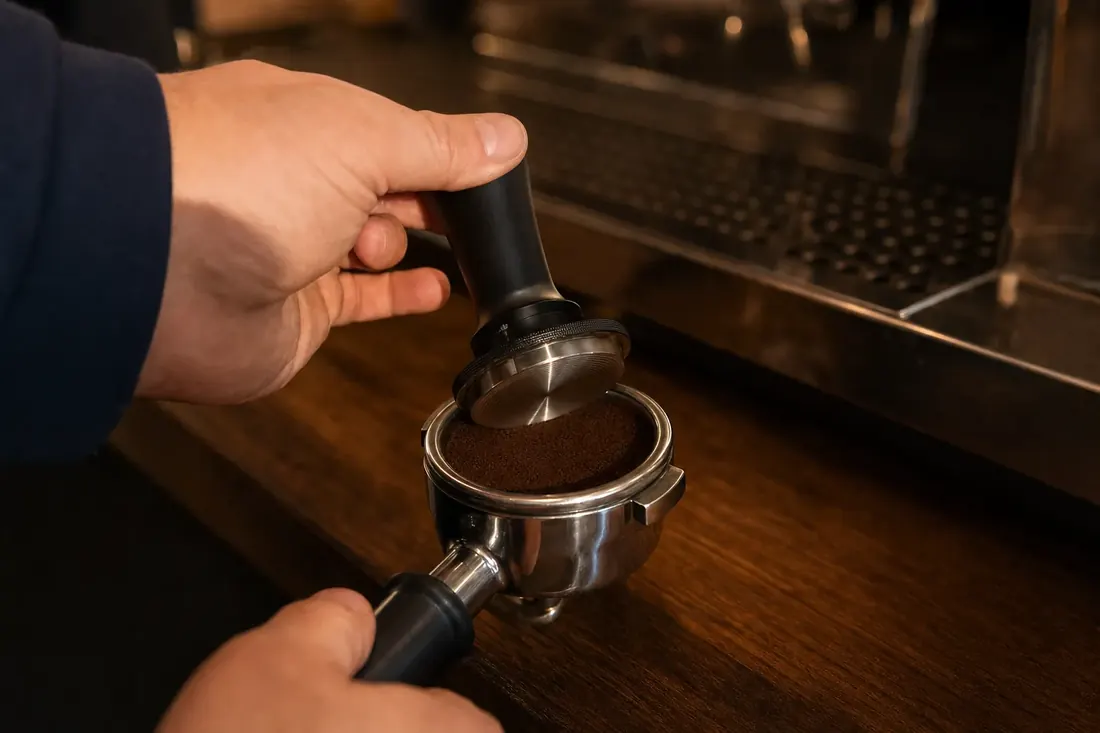
A pestle or a muddler
A pestle is the improvised option that feels most like a tamper in the hand, which is exactly why its face needs the closest look. Most pestles are domed, and not subtly: they are built to roll and crush against the curve of a mortar. A dome concentrates force in the centre of the bed and leaves the perimeter soft — the same edge problem as an undersized base, produced by shape instead of size. Convex tamper bases do exist, but their curve is a gentle deliberate thing; a pestle’s dome is a different animal entirely.
A cocktail muddler is usually the better pick from that drawer. The pressing end is flatter, the shaft is straight, and holding it vertical comes naturally. Two cautions, though. Unsealed wood drinks in coffee oils and hands them back to later shots, so bare-wood tools are for tonight, not for the month. And a muddler’s face has spent its working life against limes and sugar — soap and hot water before it touches the dose.
If the flattest end turns out to be the handle end, use the handle end. Nobody is watching, and the bed only cares about the face.
Jar lids and caps
Lids get reached for because the diameter is so often nearly right — a spice jar lid sits close to a compact basket, a preserve lid close to a full-size one. The face is the problem. Turn one over and the underside is rarely a plane: sealing rings, stacking ridges, a spiral of thread around the skirt. Each of those prints into the bed, and the thread traps grounds in places washing-up struggles to reach.
Metal lids add a second failure: thin steel flexes. Press in the middle and the centre bows away from the coffee, so the bed ends up firmer at the rim than at its heart — a hollow press from an object that looked flat. The stiffer and heavier the lid, the less this happens, but a lid stiff enough to press like a tamper is a rare find.
Where a lid genuinely helps is levelling. Laid on the loose grounds and pressed gently, it evens the surface before a firmer press with something better shaped. As half of a two-object improvisation — lid to level, glass to compress — it earns its place on the shortlist.
Wash it first, and check it for damage
Everything on this list lived another life before tonight, and all of it presses against grounds that hot water will shortly pass through. So the hygiene bar is the same as for anything else that touches food: soap, hot water, and a complete dry — water left on the face reaches the dose, and damp grounds cling to whatever pressed them.
Glass gets one extra inspection: run a fingertip around the base edge and look for chips. A chipped edge concentrates stress, and pressing a compromised glass into a steel basket with your palm above it is the one version of this evening that is not recoverable. Any damage at all, pick another object.
The coatings rule from the shortlist is a hygiene rule too. Paint, print and non-stick films sit directly against the coffee, and rubbing against a steel basket rim is exactly how such films shed. Bare glass, bare stainless, sealed hardwood — nothing else.
And if an object graduates into a regular stand-in, it inherits a tamper’s maintenance: coffee oils build a film that goes stale on any pressing face, whatever the material. How to clean a coffee tamper explains what that film does to the tamp and to the cup, and every word of it applies to a glass.
What an improvised tamp cannot give you
A well-chosen substitute genuinely compresses a bed, and tonight’s shot can be a good one. The reason it stays a stopgap has nothing to do with snobbery about kitchenware. It is repeatability, and repeatability is the entire game in espresso.
Count what moves between two improvised tamps. The diameter is approximate, so the width of the loose ring at the edge changes with where the press happens to land. The grip is improvised, so the angle wanders, and a tilted press builds a slope for water to run down. And the force is whatever your arm produced that particular morning — how much tamping pressure you need goes into how badly people misjudge that variable even with the real tool in hand.
That makes every shot an experiment with three uncontrolled inputs. When one runs fast, you cannot tell whether the grind was too coarse or the press too soft, so you adjust the grinder to chase a fault the press caused, and tomorrow’s press quietly undoes the adjustment. The bed does not care what pressed it; it cares that it is pressed the same way twice, and that is precisely what a different object in a different grip at a different angle cannot deliver.
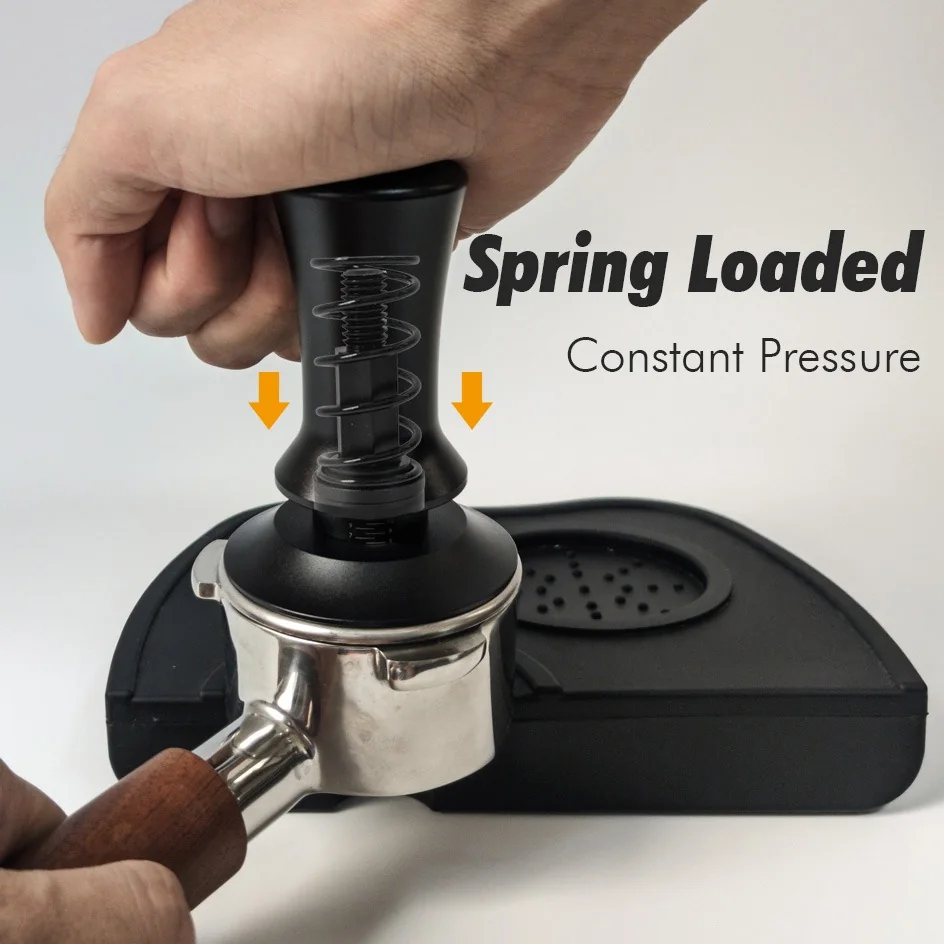
A calibrated tamper sits at the opposite end of that spectrum, which is what makes the comparison useful: its spring compresses to 15 lb and then gives way, so the bed receives the same force on every shot no matter who pressed or how the morning went. One input locked, permanently. The mechanism is laid out on the calibrated tamper page.
A DIY tamper, if you want to build one
The classic weekend build answers the third question people ask: yes, you can make one. Take a length of hardwood, cut it square, sand the pressing face dead flat, and seal it with a food-safe finish so it can be washed like the tool it is about to become. Measure the basket before you cut — the diameter is the one dimension the whole project stands on, and sanding a face flat is far easier than sanding a cylinder wider.
Do it well and you own a plain wooden tamper: correct diameter, flat face, washable, comfortable. That is a real object, and a real step up from the glass — the edge ring stops varying, the grip stops improvising.
What the workshop cannot produce is the spring. A dowel presses exactly as consistently as your arm does, which is to say: like the glass did, only with better geometry. A DIY tamper closes the diameter gap and the flatness gap; the consistency gap needs a mechanism.
Where to go next
An improvised tamp is a bridge, and a good one carries real weight: flat face, near-enough diameter, washed, pressed straight down. Nothing on this page stands between you and espresso tonight.
What none of it does is make two mornings match. When you are ready to lock that down, two pages settle it: the size guide tells you which diameter your basket takes, and the calibrated tamper makes the press itself the same on every shot.
Related reading: how to tamp espresso · how much pressure you need · what a coffee tamper is · ripple base vs flat base · tamper vs distribution tool · how to clean a coffee tamper · choosing the best coffee tamper · tamping and wrist pain
On the product: the calibrated coffee tamper · which size fits your machine · Breville and Sage fitment · what buyers report