
Coffee tamper size guide
The measurement, in one minute
basket sizes cover almost every home machine: 51, 53/54 and 58mm
— Manufacturer fitment data, 2026
Take the basket out of the portafilter. It lifts straight out; on some machines a spring clip holds it, and easing one edge up with a thumbnail releases it. Lay a ruler across the top of the basket, inside the rim, and read the widest point. That number is your tamper size, and it will land within a millimeter of 51, 54 or 58.
Two things to avoid. Do not measure the portafilter body: it is always several millimeters wider than the basket, and that gap is exactly what makes people order a tamper that will not go in. And do not measure the outside of the basket either, because the wall thickness pushes the figure up by a millimeter or so, which is enough to send you to the wrong size when you are between two.
Which machines take which size
| Tamper size | Machines that commonly take it | Notes |
|---|---|---|
| 51mm | Delonghi Dedica and most compact home machines | The most widely sold size for entry-level machines |
| 53 / 54mm | Breville, sold as Sage in the United Kingdom | Baskets quoted at 54mm usually measure nearer 53.3mm inside |
| 58mm | Full-size and prosumer machines | The commercial standard; 58.5mm variants exist for precision baskets |
If your machine is a Breville or a Sage, the fitment guide for those models lists them by name, including the ones sold under both brands. Everything else is covered by measuring.
Why the fit matters more than the price
A tamper that is two millimeters undersized leaves a ring of loose coffee all the way around the bed. When nine bars of water arrives, it goes around the puck rather than through it. The shot runs pale, fast and sour, and every instinct then says to grind finer, which makes the center of the puck denser and the edge route even more attractive. People chase that problem for weeks.
The opposite error is simpler: a tamper larger than the basket will not seat at all, and you find out in three seconds rather than three weeks. Of the two, the undersized one costs far more time, which is why this page exists and why it is the first thing we point people to.
Straight or rounded handle
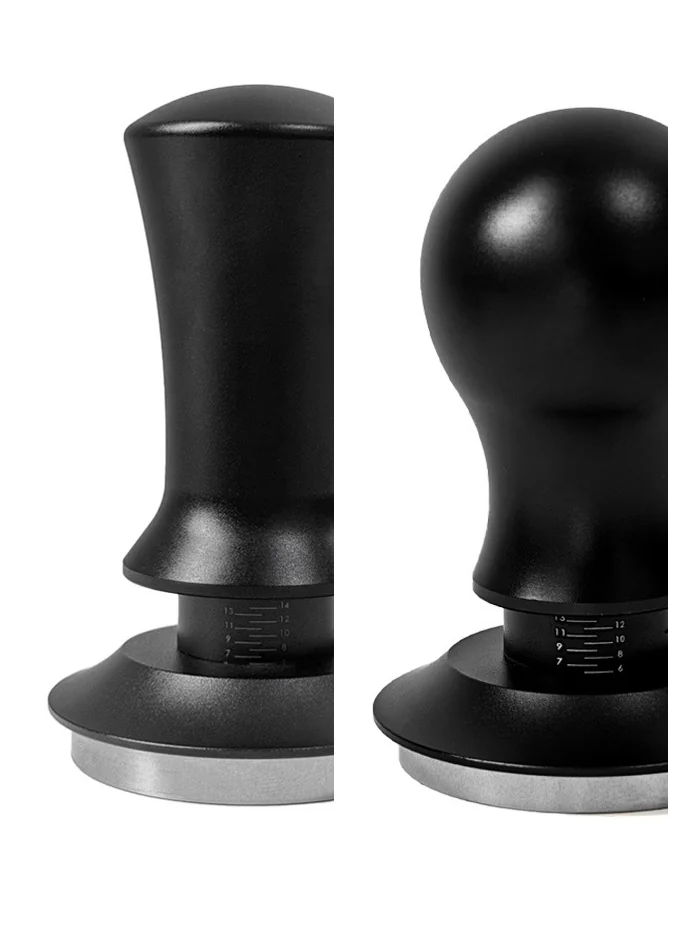
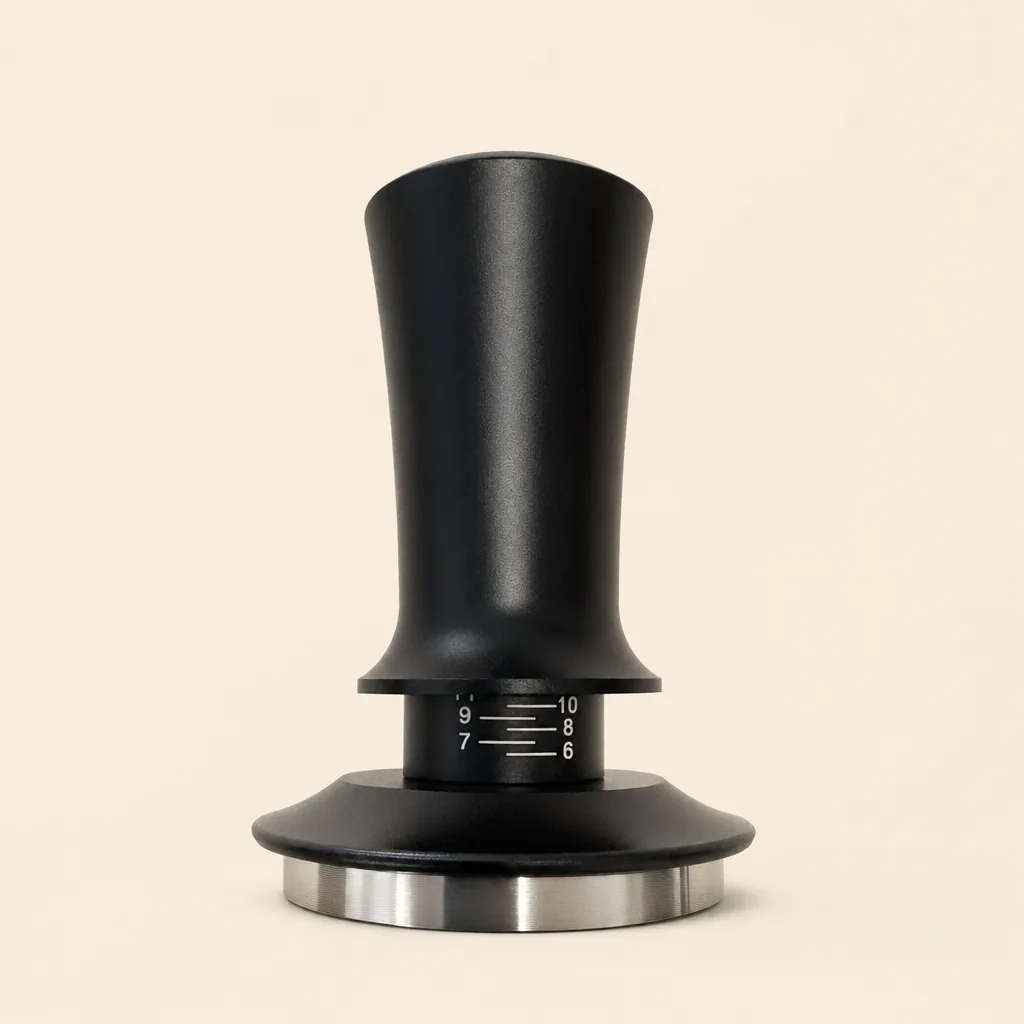
Both handle shapes carry the same base, the same 15 lb spring and the same graduated collar. The choice is comfort alone, and it is worth spending ten seconds on because you will hold it several times a day.
The straight handle is tapered and slightly narrower at the top. It suits people who push down with the heel of the palm, and it gives a bit more room for a finger-and-thumb grip near the collar. The rounded handle is a bulb that fills the hand, and it suits a wrap-around grip where the press comes from the whole arm rather than the wrist. Among photographed buyer reviews the straight handle is the more common choice, though that partly reflects which sizes were bought most.
Setting the depth once you have the right size
Getting the diameter right is the hard part. After that, the collar marked 6 to 14 sets how deep the base travels before the spring reaches its stop, and it takes one or two shots to settle. Start in the middle, dose as usual, and press until the spring gives. If the bed ends up sitting well below the rim, turn the collar down; if the spring barely travels before stopping, turn it up. That setting then stays put until you change dose or basket.
The collar does not change the force, only the depth. The full explanation is on the calibrated tamper page, along with why 15 lb is the load we stock.
Edge cases that trip people up
You have two baskets. Most machines ship with a single-shot and a double-shot basket, and both are the same diameter. Only the depth changes. One tamper covers both, and the depth collar is what you adjust when you switch between them.
Your basket is quoted in inches. A 58mm basket is sometimes listed as 2.3 inches and a 51mm as 2 inches. The millimeter figure is the one makers actually machine to, so convert to millimeters before comparing rather than the other way round.
You fitted an aftermarket precision basket. These have straighter walls and slightly larger internal diameters, which is why 58.5mm tampers exist. If your basket came with the machine, 58mm is right. If you bought a precision basket separately, check its stated internal diameter, because that is exactly the case the half-millimeter sizes were made for.
You have a pressurized basket. The one with a single small hole underneath creates back-pressure on its own and is forgiving about tamping. Sizing still matters for seating, but you will see less difference from a calibrated tamp than you would with a mesh basket. The Breville and Sage page covers that distinction, since those machines ship with both types.
If you order the wrong one
Send it back. Returns are open for 30 days and the return shipping costs you nothing, so a sizing mistake costs you time rather than money. An undersized tamper produces exactly the channelling problem the tool is meant to solve, so we would rather swap it than leave you with one that misses your basket by a millimeter.
If you are unsure before ordering, the fastest check is the one at the top of this page: basket out, ruler across the inside rim, widest point. Everything else on this site assumes you have that number. Once you do, the main product page has the three sizes and the two handle shapes, and the mechanism page explains what the spring does once it is in your hand.
Sizing questions
Do I measure the portafilter or the basket?
The basket, from the inside. The portafilter body is always wider than the basket it holds, so measuring the outside gives a number several millimeters too large and leads to ordering a tamper that will not seat. Take the ruler across the inside rim of the basket at its widest point.
My machine says 58mm but tampers come in 58 and 58.5mm. Which one?
Either will work in a standard 58mm basket; the half-millimeter versions exist for precision baskets with slightly straighter walls. If you are using the basket your machine came with, order the 58mm. If you have fitted an aftermarket precision basket, 58.5mm gives a closer fit.
What is the difference between 53mm and 54mm?
In practice, very little, and most makers treat them as one size. Breville and Sage baskets are usually quoted at 54mm and measure closer to 53.3mm inside. A tamper sold as 53/54mm is designed for both, which is what we stock for those machines.
What happens if the tamper is slightly too small?
It leaves an untamped ring of coffee around the edge of the bed. Water takes that route instead of passing through the puck, and the shot runs fast and tastes thin. This is the most common cause of channelling in a home setup, and no grind adjustment closes it.
Related: the coffee tamper · espresso tampers explained · what a tamper does · what buyers report